


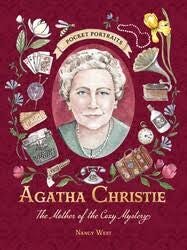
There’s more to Agatha Christie than slick plot twists and quaint settings (like the fictitious Chipping Cleghorn).
All I knew about Agatha Christie was that Miss Marple, one of her great characters, was played by Margaret Rutherford in a series of lighthearted movies in the early 60s. The titles always had “murder” in them: Murder, She Said and Murder at the Gallop, for example. The films ran at the Exeter Theater, right across the street from my Boston grade school. I figured Christie was Rutherford, a stout old lady (to my sixth-grade eyes).
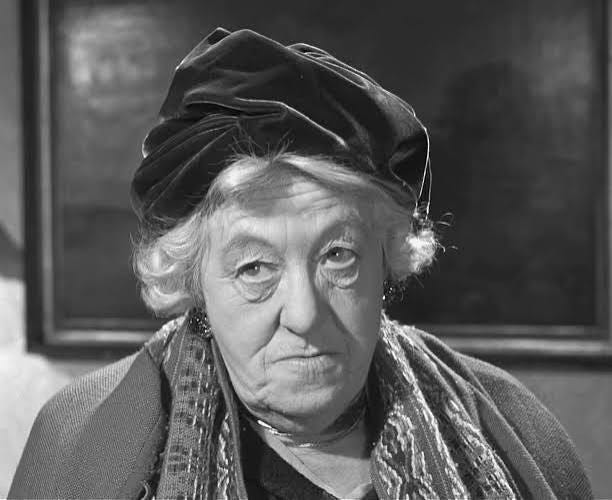
Margaret Rutherford as Miss Marple.
But Christie was an adventurous woman, said Nancy West, an English professor at the University of Missouri and author of the Christie biography, the latest in the Simon & Schuster series of pocket portraits of famous writers.
A world traveler who took up surfing in South Africa and pursued the hobby in Hawaii, Christie was one of the few British women to own her own car in the 1920s, said West. “And she liked to drive fast,” added the professor, citing British brands like the Humber Super Snipe and Morris Cowley among Christie’s vehicles of choice.
The lady was feisty. “I don’t want sentences twisted around to be more grammatical when they are part of someone’s spoken conversation,” she told her editors. She’d have hated Grammarly.
West notes that Christie wrote at a time—early in the 20th century—when female detective writers were making a name for themselves. You had Dorothy Sayers, Patricia Wentworth, Gladys Mitchell, Margery Allingham, and let’s not forget Mildred Wirt Benson, who created Nancy Drew in 1930. Christie, herself liked the work of Elizabeth Daly, author of Unexpected Night, noted West.
Christie was already an established writer in 1926 when her husband of 12 years asked for a divorce. The impending break-up caught Christie off-balance. West thinks she may have initially sought to end her own life by driving her car off an embankment, but hedges saved her.
Christie’s “disappearance” became a major press event in England as thousands combed the countryside, looking for the missing mystery writer. Instead of doing herself in, it turns out Christie had a change of heart and enjoyed a 11-day holiday at a Yorkshire hotel.
Christie soon got back to writing—not just mysteries and plays—but she also joined fellow mystery writers like Dorothy Sayers to deliver original mysteries on BBC radio. West said she also jumped at the chance to adapt her own stories as radio plays such as Miss Marple Tells a Story in 1934.
Christie was nothing if not prolific. In addition to all the stories she produced under her own name, she also penned six novels under the pseudonym Mary Westmacott. These weren’t mysteries but semi-autobiographical fiction.
Christie first took the Orient Express in 1928. She published Murder on the Orient Express in 1934. But Christie and her second husband didn’t do much globetrotting when war broke out. They elected to stay in London, braving the Blitz. Through it all, she kept writing, producing, among other things, The Mousetrap, the longest-running play of all time.
A writer is fortunate to develop one literary character to draw a reader’s attention. Christie came up with two: Hercule Poirot (who starred in 33 novels) and Miss Marple (who starred in 12 novels). Both have also been repeatedly featured in movies and TV adaptations. The latest Hercule Poirot TV series will air in 2027, West said.
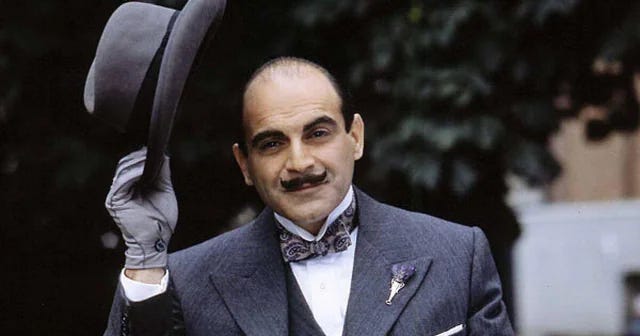
David Suchet as Hercule Poirot.
As for a favorite characterization, West said David Suchet’s work as Poirot on British television between 1989 and 2013 is outstanding. She also recommends the 2015 TV adaptation of And Then There Were None.
When Christie died in 1976, she left behind an estate worth just over 110,000 pounds, not the lavish fortune one would expect from the woman who sold millions of books in her career. West said she was caught up in British tax laws that dogged Christie throughout her life.
The title of West’s biography is Agatha Christie, The Mother of the Cozy Mystery, but West doesn’t believe Christie would appreciate that title. Her book, And Then There Were None, not only isn’t the least bit cozy; “it’s so existentially bleak, it’s terrifying,” she said.
For her next book, West said she plans an account of her experiences as a youth attending films and film houses in 1970s’ New York with her father. She recounted one episode where, as an eight-year-old, she recognized Greta Garbo on the streets of New York City.
“We followed her for blocks until Garbo went into an automat where we watched her eat a piece of pie,” recalled West. The eight-year-old planned to approach the reclusive star to talk to her, even though she knew Garbo’s famous reputation for privacy. “I thought she’d want to talk to me, but then I chickened out,” she laughed.