

AIRSHIPS
Will they lift us again?


Few writers liked airships more than Philip Jose Farmer, Peoria’s sci-fi master. Airships played a major role in Farmer’s epic Riverworld series (see the cover of The Dark Design, the third book in the series). Farmer also penned The Wind Whales of Ishmael, a story about a future world without water where whales soar through the sky.
It was the view of a whale of an airship as a child—when Farmer viewed the USS Shenandoah pass overhead Peoria in 1924—that probably triggered a lifelong attachment for the author.
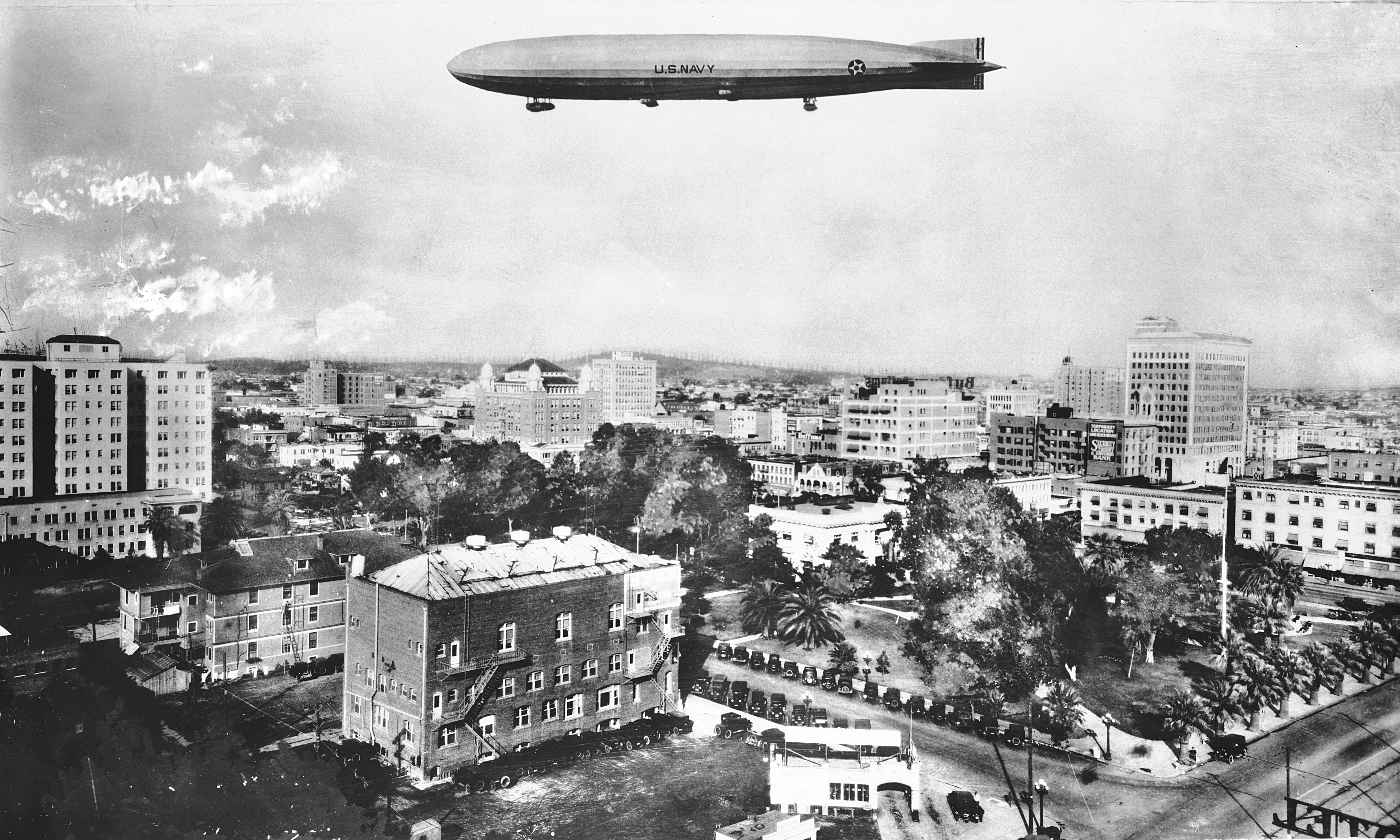
The Shenandoah over the city of Long Beach, Calif. in 1924.
The 680-foot Navy airship (remember the Goodyear Blimp is only 246 feet long) would have been something to see in the 1920s, with aeronautics just getting underway. The craft was on a cross-country tour at the time (a tour that National Geographic dedicated 47pages to in its January 1925 edition). A year later, the Shenandoah crashed during a storm in Ohio, killing 14 men.
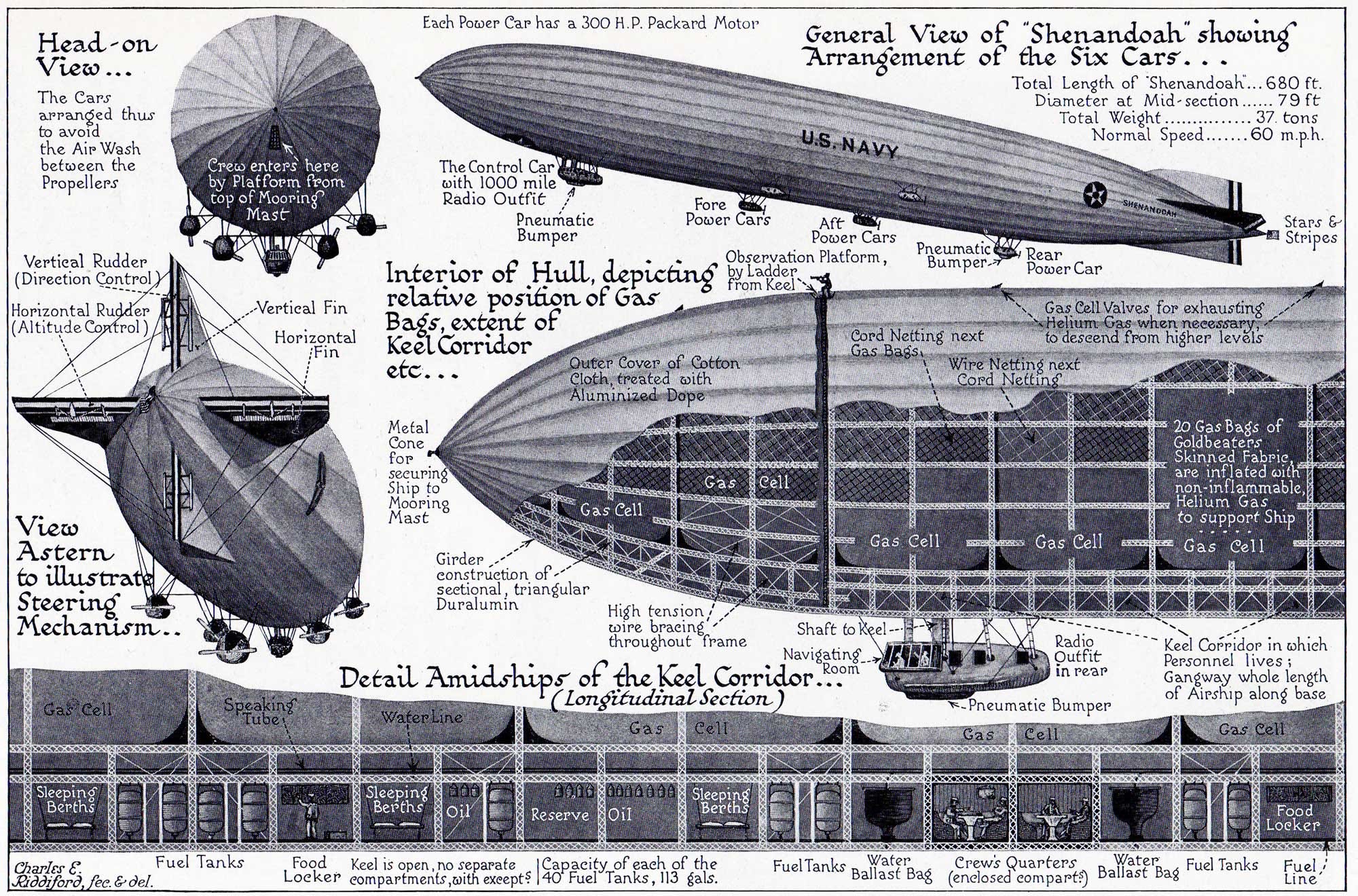
National Geographic artwork on Shenandoah airship (January, 1925).
Our history of the airship tends to focus on accidents that have occurred, something that’s probably not surprising considering the frequency of high winds and that fires involved volatile hydrogen gas that was often used. The Hindenburg disaster of 1937 enshrined for posterity the dangers involved, on display through newsreels and radio commentary (“Oh, the humanity…”)
If you’ll pardon the pun, however, things may be looking up for the airship these days. After several unsuccessful projects over the decades, airships finally seem to be on the brink of returning as viable green modes of transport, for both passengers and freight.
\History was made when the Pathfinder-1 airship, the first giant rigid airship built in over 90 years, flew over San Francisco’s Golden Gate Bridge last year in October. Google co-founder Sergey Brin built the 400-ft-long helium-filled craft for his company called LTA (Lighter Than Air).
LTA CEO Brett Crozier maps out the future for the airship: “As we continue testing and training over the San Francisco Bay Area, each flight brings us closer to a future where safety, reliability, and innovation in lighter-than-air technology redefine what’s possible. With Pathfinder 1, LTA is not just testing an airship — we’re laying the foundation for a new era of electric aviation that can transform how the world moves cargo and people.”
In November 2025, many of the 13,000 people who attended Slush, the annual technology and start-up event in Helsinki, Finland, took to social media to report a shimmering silver UFO flying over the city, noted Mark Piesing in the February 2026 edition of Aero Space magazine. But it wasn’t a UFO, but a small, semi-rigid airship drone built by Finnish start-up, Kelluu, which now flies probably the largest airship fleet in the world.
When the Forest Agency needed to transport logs out of remote regions of France, it turned to a radical idea: an airship. In July 2025, France’s Flying Whales Services signed a contract with the French National Forest Agency for the lease of four to six of its huge airships.
In a June 15 post on autonocion.com, Luis Reyes noted that “wind turbines have spent the last two decades getting taller for one stubborn reason. The higher the blades sit, the better the wind gets up there: steadier, stronger, and more of it. The problem is that height is expensive. A taller turbine needs a heavier steel tower and a deeper concrete foundation to keep the whole thing from toppling, and past a certain point, the extra few meters of altitude stop being worth the steel. A Chinese company looked at that trade and decided the tower was the part worth deleting.
“Back in January, near the city of Yibin in Sichuan Province, a helium-filled airship roughly the size of a basketball court carried a cluster of wind turbines up to 6,560 feet, held position, and fed 385 kilowatt-hours of electricity straight into the local grid, according to the state-backed Global Times. The developer, Beijing Linyi Yunchuan Energy Technology, calls the machine the S2000, and bills it as the first megawatt-class airborne wind system built for use near cities. It’s believed to be the first time a megawatt-rated flying turbine has generated power at altitude and synchronized it cleanly onto a terrestrial grid. The output was modest. The idea behind it is not,” said Reyes.
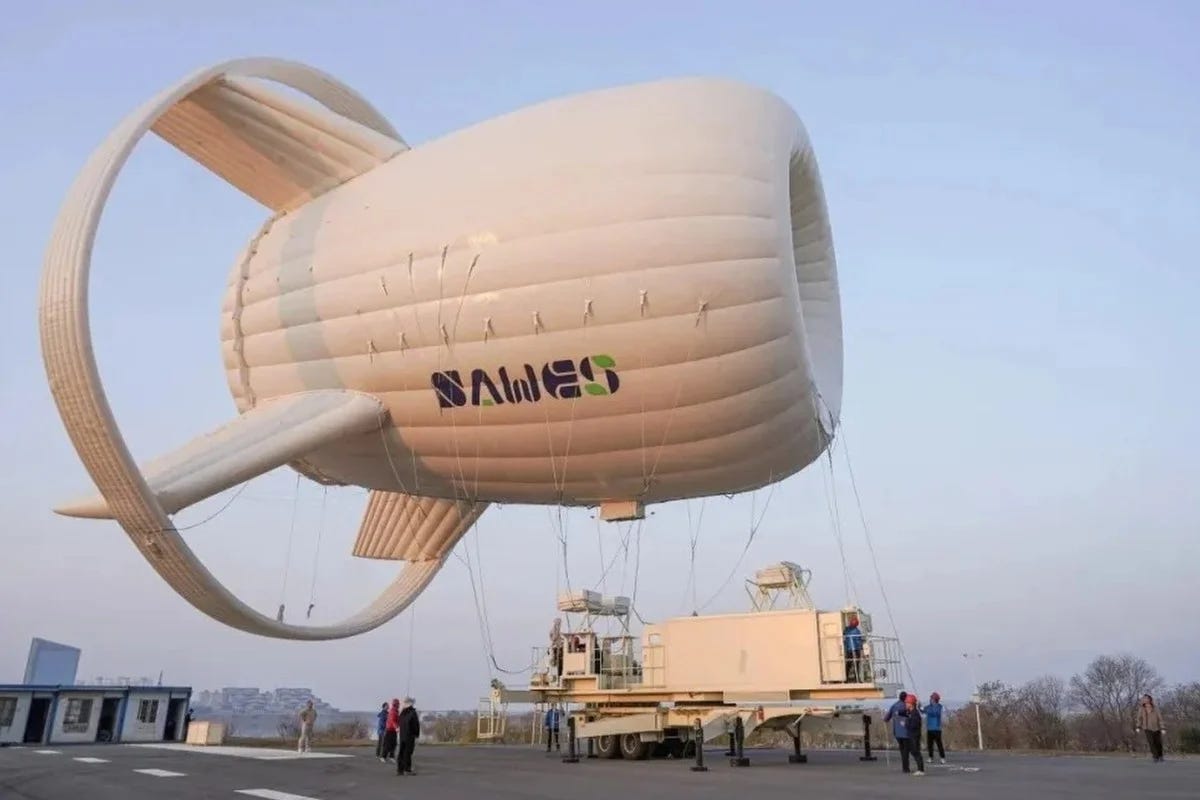
Chinese researching ways to give wind turbines a lift.
So, over 100 years after Farmer’s sighting, the airship may be floating into view again to inspire and uplift.