
BIZ MACKEY
The star catcher in the Negro Leagues mentored Roy Campanella.

There’s always more than one element to a story. The Read Beat interview with Robert Fitts, author of Banzai Babe Ruth, focused on the Babe’s barnstorming tour of Japan in 1934. Ruth was at the end of an illustrious career and had to be talked into making the month-long trip to Japan, but he served as the ultimate good-will ambassador both on the field and off while in Japan.
But there were other items of interest.
One was the role that Lefty O’Doul played in making the 1934 trip a success. O’Doul, a slugging outfielder for the New York Giants, helped organize a previous barnstorming tour of major leaguers to Japan in 1931.
He wound up returning to the Asian nation numerous times and is credited with helping develop baseball in Japan, a country he loved. O’Doul was the second American to be installed in the Japanese Baseball Hall of Fame (the first was Wally Yonamine).
Everyone knows baseball legends like Ruth, Ty Cobb, Lou Gehrig, Rogers Hornsby, and Walter Johnson, but you usually don’t hear O’Doul’s name alongside those others. The fact is, he belongs. His lifetime average over seven seasons was .349.
Here’s the other thing about O’Doul. He started as a pitcher but suffered a sore arm and went back to the Pacific Coast League where he developed into a hitting outfielder. He returned to the big leagues in 1928 at the age of 31. The following year, now with the Philadelphia Phillies, O’Doul batted .398 with 254 hits.
Another player of note on that 1934 barnstorming trip to Japan was Moe Berg, a catcher with the Detroit Tigers. In addition to his catching duties on the field, Berg is believed to have served as a spy during his time in the country, photographing Japanese installations as the team moved about the country
Still another reference made in the interview with Fitts was the fact that numerous barnstorming trips were made to Japan by teams from the United States prior to the 1934 tour. Previous trips included U.S. collegians and Japanese-American ballplayers. The Negro Leagues also sent players on a barnstorming tour of Japan in 1927 (the year Ruth hit 60 homers).
Among the players mentioned on that Negro League trip to Japan was Biz Mackey, a catcher who slugged three home runs out of Tokyo’s Meiji Jingu Stadium during the trip.
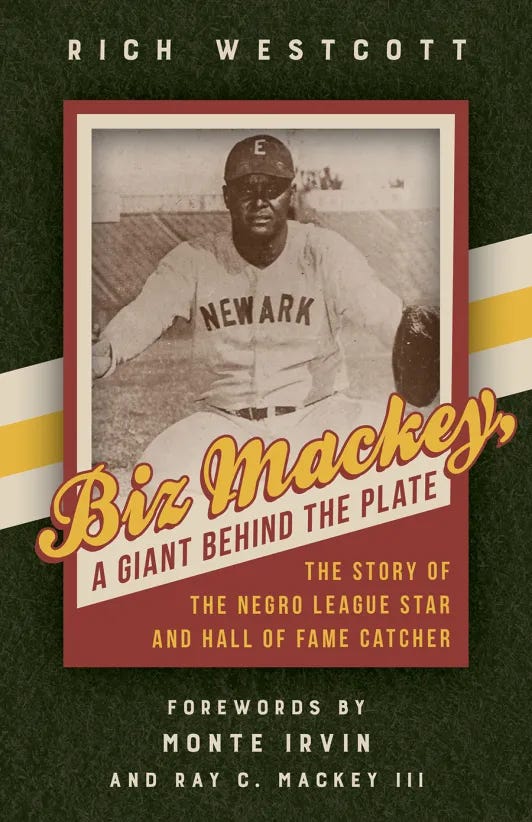
What I found out about Mackey was fascinating. In his book, Biz Mackey: A Giant Behind the Plate, Rich Westcott noted that Mackey played professionally from 1920 until making his last at-bat in 1947 at the age of 50. According to black baseball historians Larry Lester and Dick Clark, his lifetime batting average was .327.
Biz spent nine years playing in Philadelphia, including six with the Hilldale Daisies and three with the Philadelphia Stars. He led both teams to victories in the Negro League World Series—the Daisies in 1925 and the Stars in 1934. In those days, Philadelphia was one of the major cities in Negro League baseball. Games, including some played at Baker Bowl and Shibe Park, were big attractions, not only to black fans but to white fans as well, said Westcott.
Mackey was not only considered a solid hitter but a defensive whiz behind the plate, maybe the best there ever was. Biz came by the nickname because he enjoyed giving hitters the business when they stepped up to bat.
Biz was saluted by Roy Campanella in an exhibition game between the L.A. Dodgers and New York Yankees in 1959 (attended by 93,000 at L.A. Coliseum). The Dodger catcher whose playing career ended after an automobile accident left him paralyzed the previous year cited Mackey as his mentor and the man who taught him the catching skills that made Campanella a star.
Westcott called Mackey’s career a glittering one as player, manager, and innovator. As Paul Harvey used to say, “And that’s the rest of the story.” But there’s plenty more, folks.