
CUBA
What's the United States got against this island nation?

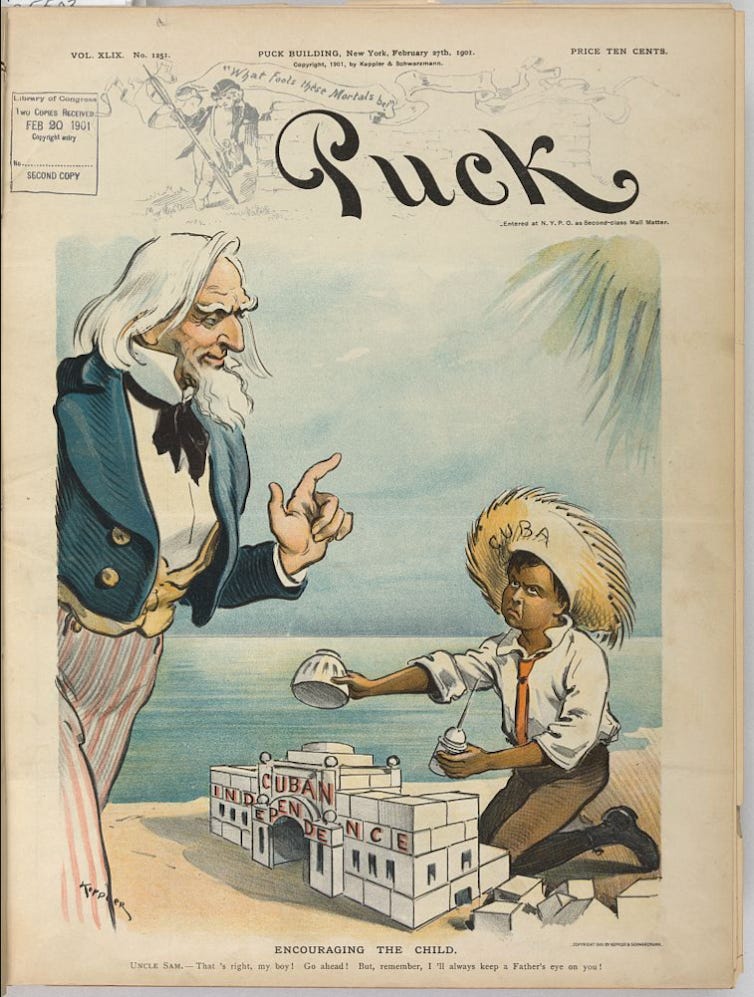
Where do we start with U.S.-Cuban history? Remember the Maine? That’s the U.S. warship that exploded back in 1898. War between the United States and Spain followed, ending Spanish rule over the island, which it had held as a colony for 400 years.
The United States, which tried to buy Cuba from Spain in the mid-19th century, occupied Cuba from 1898 to 1902 and again from 1906 to 1909.
When Fidel Castro came to power in 1959, there was a brief period of optimism in the United States before major land reforms and nationalization pushed U.S. companies out of the country. Cuba became communist, and things went downhill from there.
Cuba played big during the early 60s. The Bay of Pigs invasion of 1961 became President John Kennedy’s greatest presidential failure. That was followed by the Cuban Missile Crisis in 1962, which might have been JFK’s greatest accomplishment.
The years went by as Castro maintained power.
Then came signs of hope that the two countries might be able to get along. In 1999, Illinois governor George Ryan, a Republican, led an official delegation to the island. Ryan was the first U.S. governor to travel to Cuba since the 1959 revolution, leading a humanitarian and trade mission that featured a meeting with Castro.
John Block, who served as President Ronald Reagan’s Secretary of Agriculture in the 1980s, also visited Cuba with a delegation in 2000. Block said it made no sense for the United States not to trade with Cuba. He said the Caribbean island, just 90 miles from the United States, represented a potential market worth $1 billion a year for U.S. food exporters. ``When the Russians were the ‘evil empire’, I signed trade agreements with them,’‘ said Block, who was serving as President of Food Distributors International, an association of food wholesalers, at the time.
That same year (2000), Castro signed an oil deal with Venezuelan President Hugo Chavez.
In the 21st century, it’s been a case of ups and downs with U.S. treatment of Cuba, depending on who’s president at the time. President Barack Obama visited Cuba in 2016, the same year that Fidel Castro died at the age of 90. Obama loosened restrictions with Cuba, only to have President Donald Trump reinstate them when he took office in 2017.
In 2018, Raul Castro, Fidel’s brother, stepped down as the nation’s leader. In 2022, President Joe Biden eased restrictions on the country but once again, with his return to the White House in 2025, Trump restored a hard-line policy.
Now Raul Castro is back in the news. At age 94, he’s just been indicted by the U.S. Justice Department. The U.S. is charging the former president in connection with the downing of two planes carrying “Brothers to the Rescue” anti-government activists in exile, killing four, back in 1996. The incident was the culmination of months of provocations, with regular incursions into Cuban airspace by Brothers to the Rescue planes, according to the Drop Site news agency.
CNN reports that the indictment of Raul Castro “comes at a tense time for US-Cuban relations, with the Trump administration declaring the Cuban government is a threat to US national security. Cuba is also dealing with a collapse of its energy sector due to an oil blockade following the U.S. attack on Cuba’s oil-rich ally Venezuela.”
The New York Times reports that widespread blackouts are common on the fuel-starved island. The country of some 10 million people (2 million in Havana) is “trapped in the vise of a repressive regime and punishing American sanctions,” the paper stated.
The year 2026 has been eventful, to say the least, when it comes to U.S.-Cuban relations. Here’s a closer look at developments this year between Cuba and the U.S, compiled by PBS:
On Jan. 4, Secretary of State Marco Rubio declared Cuba’s government was “in a lot of trouble,” as the president renewed calls for an American takeover of the Danish territory of Greenland. Trump fired off a warning to the Cuban government on Jan. 11, calling for the Cuban government “to make a deal before it is too late.” Trump signed an executive order on Jan. 30 to impose a tariff on any goods from countries that sell or provide oil to Cuba.
On Feb. 27, a day before the war in Iran began, Trump said the U.S. was in talks with Havana and raised the possibility of a “friendly takeover of Cuba,” though he didn’t offer any details. Trump didn’t clarify his comments but seemed to indicate that the situation with Cuba was coming to a critical point.
On March 13, the Cuban government announced that Cuba and the U.S. held talks, marking the first time the Caribbean country confirmed widespread speculation about discussions with the Trump administration. Senate Republicans rejected legislation from Democrats on April 28 that would have required Trump to abide by Congressional approval to end the U.S. energy blockade on Cuba.
On May 18, the State Department imposed a new layer of sanctions on several Cuban government agencies, including the Interior Ministry and National Police and Intelligence Directorate, as the Trump administration continues to ratchet up pressure against the island.
On May 21, the Associated Press reports that President Trump said past U.S. presidents have mulled intervening in Cuba for decades, but “it looks like I’ll be the one that does it.”
Cuban President Miguel Díaz-Canel drew parallels between the Cuban Revolution’s resistance to U.S. imperialism in 1961 and the island’s current standoff with Washington—while issuing a defiant message indicating that the government is at least preparing for the possibility of an armed confrontation.
“The moment is extremely challenging and calls upon us once again, as on that April 16, 1961, to be ready to face serious threats, including military aggression,” said Díaz-Canel.
As the governments spar with one another, the Cuban people see one hardship pile up on top of another. “In a country once revered in much of the world for its public services. Havana is almost completely dark at night, with its aging electrical grid reliant on fossil fuels and the little gas there is reserved for essential services like hospitals. The Cuban government has reported that the medical system has been forced to postpone surgeries for over 100,000 patients, including 12,000 children,” noted Ryan Grim in a May 21 story for Drop Site.
In recent days, the United States has repeatedly made a public offer of $100 million of humanitarian assistance to the people of Cuba, as the island has fully exhausted its fuel reserves amid an oil blockade implemented by the same country offering the assistance, added Grim.
The Cuban government has worked together with the Catholic Church via the aid group Caritas to receive U.S. humanitarian assistance but if the U.S. did deliver food and medicine, the Church would have enormous difficulty distributing it—not just due to a lack of organizational infrastructure, but the lack of gas makes shipping it around the island impossible.
“In the same manner that Cuba provides free healthcare for its people, but cannot conduct surgeries due to lack of electricity, we should expect that delivering aid to millions of people without fuel becomes extremely difficult,” said Reverend Claudia de la Cruz, executive director of The Interreligious Foundation for Community Organization (IFCO) / Pastors for Peace in the Drop Site story.
De la Cruz says her organization speaks from first-hand experience; IFCO / Pastors for Peace has over three decades of experience working in Cuba, having sent a contingent to Cuba twice in the last five months to deliver humanitarian aid.
Writing in the May 12 edition of The Conversation, Ramon Espinosa stated, “Trump has now reverted to Washington’s traditional neo-colonialist view of Cuba, proclaiming he can do what he likes with the island. Perhaps it is time to try a new approach. As the spectacular debacle of the US-backed Bay of Pigs invasion showed 65 years ago, Cubans remain ready to defend their independence and their right to determine their own future.”
Perhaps it’s time to learn from history. Maybe it’s also time for the American people to try to identify with the people of Cuba rather than their government.