

Downtown USA
Bouncing back remains a challenge for many small towns.

If you passed through small-town America in recent years, you may have noticed, for the vast majority of towns, to use the phrase, “they ain’t what they used to be.” The downtown buildings may still be in place, but they’re empty or boarded up. That’s if you even make it to the downtown area to see for yourself now that some businesses have migrated to the highway to serve the traveling public.

Erik Reader seeks to do something about that. He heads his own consultancy, Reader Area Development, that works to bolster downtowns across the country. Reader has worked to promote Muscatine, Iowa, as well as Rock Island and Peoria in Illinois. He recently served as director of Illinois Main Street, a division of Main Street USA.
As a result of his interest in downtown development, Reader has visited many towns and met with many community leaders who want to make their town better. He understands what a lot of folks have gone through. “They’ve had the strategic plans. Committees have met, but things aren’t moving. The people carrying the load are getting tired,” he said.
He’s also seen what has succeeded at the small-town level: the profusion of national chain stores like Casey’s and Dollar General in many communities. “Fresh concrete, large parking lots, bright corporate branding, and highway visibility define the commercial gateways of many small towns,” Reader said.
Rather than blaming the chains, Reader suggests learning from them. The chain stores succeed because they serve a need, he said. Small towns can also serve a need by providing a unique or consistent attribute to attract the visitor looking for that unique experience.
Reader acknowledged Galena, a town of 4,000 in northwest Illinois, as one of those small towns that’s been able to reinvent itself. The rolling hills, well-preserved downtown buildings, fine restaurants, and a historic connection (Ulysses S. Grant’s hometown) make Galena what it is today, he said. But in the 1970s, Galena wasn’t the tourist attraction it is now, said Reader, adding that the community had to work to put the pieces in place.
Other communities have done the same thing, said Reader, pointing to Door County, Wisc., as a region where small towns have maintained their appeal for decades. But now that a vacation home costs $800,000 or more, even scenic Door County may face a challenge, he said.
Reader cited successful efforts across the Midwest, citing Western Michigan towns on Lake Michigan, Branson, Mo., Decorah, Iowa, and Havana, Ill., as examples.
People are looking for a reason to get out, and the enterprising small town that can land a spot on the pork tenderloin trail or come up with that quirky connection can provide an outlet.
Consider what the Hinckley Historical Society came up with to celebrate the town of 2,000, 15 miles south of DeKalb, Illinois: “On Jan. 7, 1927, the Harlem Globetrotters basketball team played their first game in Hinkley, Illinois (before the “c” was added)…The Globetrotters were organized as an exhibition team in their hometown of Chicago, Illinois. The original team, the so-called ‘Savoy Big Five,’ was named after the legendary ballroom (the Savoy) where the team played games before dances.”
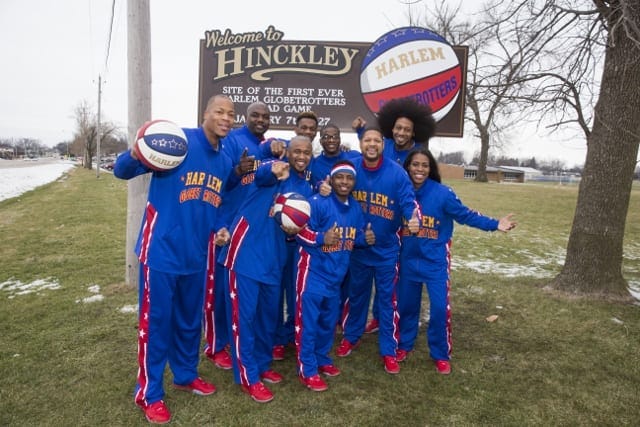
Photo of the Harlem Globetrotters in 2024. (Hinckley Historical Society)
So who had their first game in your town?
To hear an interview with Erik Reader:
https://www.buzzsprout.com/admin/1950812/episodes/19410380-america-s-downtowns-a-conversation-with-erik-reader