

ELECTRIC CARS
Americans playing hard to get when it comes to EVs.

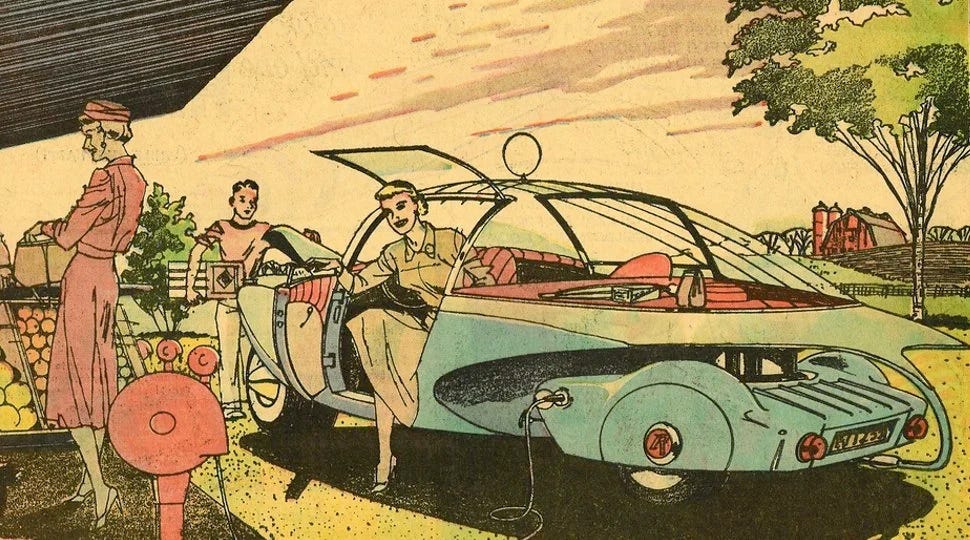
Artist rendering of the future penned in 1959.
The whole world is going electric—with one exception. While electric vehicles continue to roll out of showrooms at a rapid rate around the globe, here in the United States, we’re still stuck in gas-powered traffic. A New York Times story recently quoted auto journalist Martin Padgett noting that America “pulled a U-turn while the rest of the world has pushed forward.”
The sale of EVs, as they are known, fell sharply in the United States in the fourth quarter of 2025. With the elimination of the $7,500 federal tax credit, sales dropped to the lowest point since the fourth quarter of 2022, according to Cox Automotive.
Looking at a sluggish U.S. market, car companies reacted quickly, not only taking planned electrics off the drawing board but delaying or eliminating the rollout of electric vehicles that had been lined up for production lines. Ford cancelled a new SUV and called an end to the F-150 Lightning, the electric pickup it launched in 2021. General Motors scotched a Buick SUV along with the Chevrolet BrightDrop commercial van. Hyundai said it wouldn’t ship any more Kona electrics to the U.S. market, according to Business Insider.
Honda cancelled three new electric models along with announcing that the Prologue, the only all-electric vehicle still on the Honda lot, would be discontinued in this country later this year.
Several reasons are advanced as to why the American motorist isn’t getting a charge out of the electric car: vehicle cost (especially in light of the elimination of federal tax incentives); concern about battery life, otherwise known as range anxiety; and worries about the availability of charging stations.
While not unjustified, concerns may be a little dated. The average cost of a new vehicle in 2026 is $49,758, according to Kelley Blue Book. You can buy any number of electric vehicles for that price. Opportunity is also knocking for the savvy buyer now facing a dealer with a surplus of electric merchandise to sell.
As for range, a growing number of EVs now run over 300 miles on a single charge. There’s an electric Chevy Silverado that provides over 490 miles on a charge. While the feds dropped the tax credit on the purchase of an electric vehicle, there are still federal, state, and utility incentives available for home charging stations to defray the station’s estimated $1,600 cost.
As for the number of charging stations in your neighborhood or along your commuter route, that still depends on where you live, but public charging stations have doubled in this country since 2022. That’s according to the International Energy Agency. You don’t hear a lot about it, but franchises like Taco Bell, Starbucks, and McDonald’s are stepping up efforts to work with charging networks across the country. Bojangles chicken outlets (there’s one in Normal, Ill.) have been particularly focused on attracting electric customers with places to charge up while they chow down.
Of course, there’s the high price of gas these days and sparing the environment but Wired recently raised another benefit for having an electric vehicle: You can send power back into the grid—and get paid for it. “EV batteries are an existing, widespread, and reliable source of backup energy to tap into in times of high demand, like during the summer when everyone is running their air conditioning,” noted Matt Simon in the July 26, 2026 issue of Wired.
For all the benefits of an EV, Zachary Shahan, who writes for the CleanTechnica website, a site that regularly sings the praises of alternative energy, thinks Americans have to get over another hang-up before they can fully appreciate electric vehicles.
“As long as an EV is offering less space and a less towering presence than a comparably priced gas-powered vehicle from the same brand, I think we’re going to struggle with EV adoption. I’d like to say otherwise, because of all the benefits EVs bring, but it just seems that size matters most here,” he said.