

FILM NOIR
It's more than just films.

The beauty of film noir is that there are so many ways to consume it. There are the films, of course.
There is also a lot of reading material to consider. You know the big names by now: Raymond Chandler, Dashiell Hammett, Cornell Woolrich, and James Cain, the authors who conceived of hard-boiled privates like Philip Marlowe and Sam Spade. But the noir fiction category also includes Graham Greene, Jim Thompson, James Ellroy, and David Goodis, along with Megan Abbott, Walter Mosley, Rachel Howzell Hall, and Sue Grafton, to name a few.
The literary side of noir is vast, so be warned: once you head down that dark alley, you may not get back.
Want to define noir? You can find 100 different variations, but here’s what the Audible company came up with: “The characters are never completely good or utterly bad, and there’s usually an internal struggle. Noir is distinguished by its gloomy and gritty settings…Even if the lead characters ultimately reach their goal, they are forever changed by the events they’ve witnessed and experienced.”
Arthur Lyons, author of Death on the Cheap, a look at B-movie noirs, offers another definition of noir. “In the noir world, all characters, including cops, are motivated by obsession—by money or lust—or suffer from alienation or loneliness. Even the private eye, the protagonist closest to being a noir hero, is not exempt from this fate. His experience has shown him that everything in the world is corrupt, that nobody is safe; he can trust no one, not even someone he loves.”
Lyons goes on to talk about Sam Spade sending up Brigid in The Maltese Falcon, but you knew about that.
You don’t have to use your eyes to take a trip through treacherous terrain. You can use your ears with audiobooks and old radio shows.
Smartphones now drive the audiobook segment, and it’s a growing market. But the old radio shows that now abound online provide several benefits of their own. For one, many of the old radio shows of the 1940s and 1950s were produced at the same time that Hollywood was churning out what is now considered the classic period of film noir (from WWII to the late 50s).
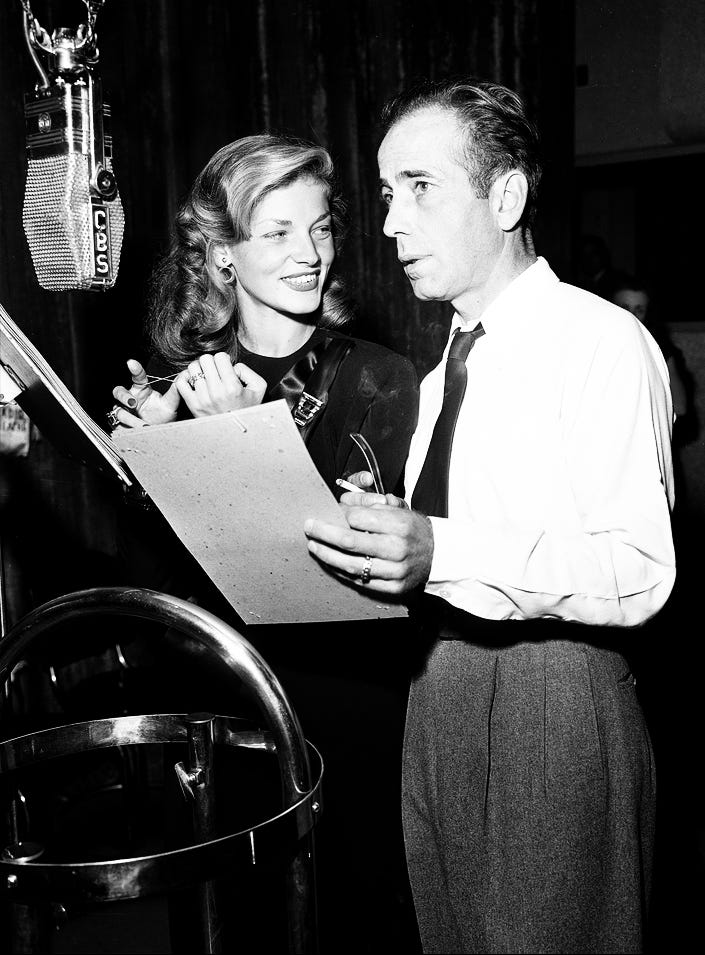
Lauren Bacall and Humphrey Bogart on the air.
Radio can throw you a few curves, too. Shows like the Lux Radio Theatre or Screen Directors Playhouse offered numerous faithful (albeit shortened) versions of film noir favorites, featuring the stars of the movies themselves. But sometimes there were casting changes like Cary Grant playing Uncle Charlie in Hitchcock’s Shadow of a Doubt instead of Joseph Cotton. On a Lux program, Edward G. Robinson played Bogie’s Sam Spade role in Maltese Falcon.
Along with listening to, reading, or viewing noir, you can also read noir film history, another growing field.
Take Double Indemnity, for example. Recognized as a film noir classic, there’s a lot to say about this one. Let’s start with Lyons: “…it was not until director Billy Wilder teamed up with pulp writer Raymond Chandler to write Double Indemnity in 1944 that noir production really took off. Double Indemnity was an immediate smash hit, and soon the studios were cranking out Double Indemnities by the dozen.”
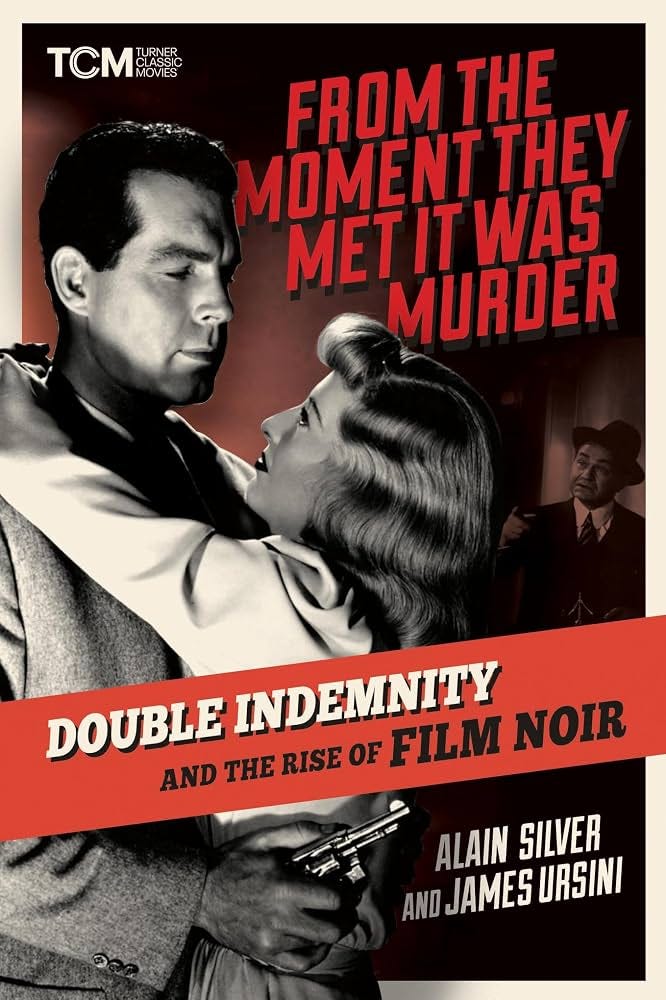
Alain Silver, the film producer-director-screenwriter who has produced a vast amount of noir history, devoted an entire book to the film along with fellow author James Ursini, From the Moment They Met It Was Murder. Everything you ever wanted to know about Double Indemnity (such as why Fred MacMurray took the role when he didn’t want to or why they cut out the gas chamber scene at the film’s end) is in there.
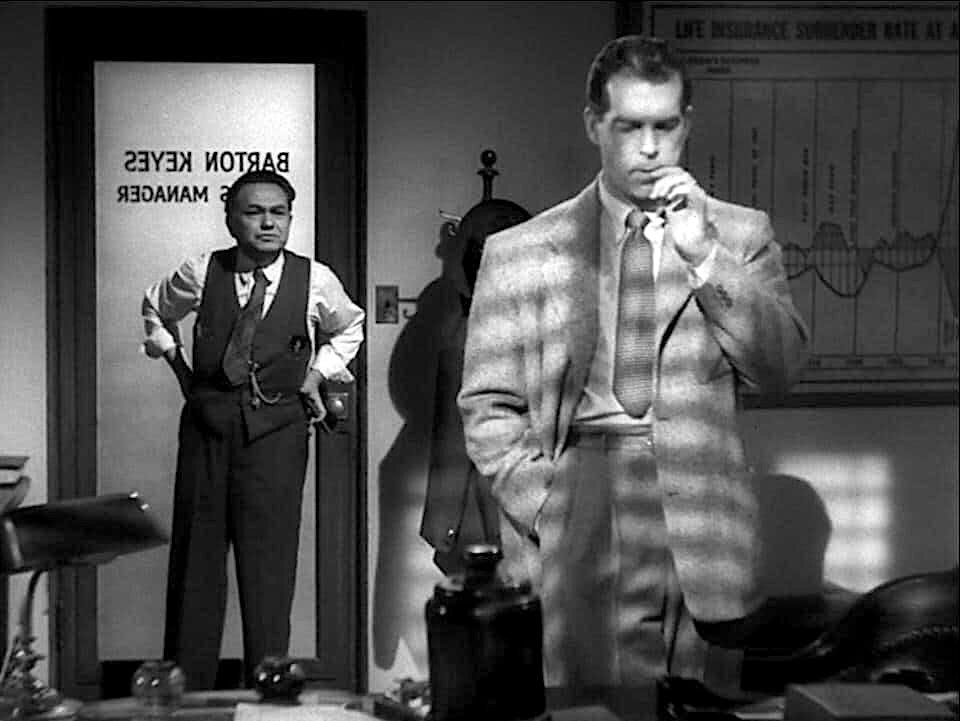
Robinson and MacMurray in Double Indemnity.
Silver and Ursini had this to say about Edward G. Robinson, who starred in the film along with Barbara Stanwyck: “By the time he played Keyes Edward G. Robinson was already an icon. Not only for his proto-noir gangster roles at Warner Bros. but also for mainstream dramas like the biographical Dr. Ehrlich’s Magic Bullet (1940) and Jack London’s The Sea Wolf (1941). He was considered the ultimate professional and amazed his fellow actors with his ability to memorize and deliver long dialogue scenes, like his explanation of various types of suicides and poisons in Double Indemnity.”
Michael Keaney’s Film Noir Guide offered this: “MacMurray and Stanwyck’s romance matches the entire atmosphere of the film, and even MacMurray’s annoying overuse of the word ‘baby’ can’t spoil it. The brilliant screenplay and Robinson’s sensational portrayal of an ace insurance investigator more than overcome the film’s few shortcomings.”
Keaney’s guide not only scores the noir pictures (Double Indemnity gets 4 ½ stars out of 5) but adds little tidbits like memorable noir moments (particularly noirish dialogue or actions) and familiar faces from television (often spotlighting TV regulars who once appeared in film noir). For example, did you know that Hugh Beaumont, TV’s Ward Cleaver in Leave It to Beaver, played Michael Shayne in a series of low-budget detective shows in the 1940s?
Eddie Muller, the czar of noir himself and host of the Turner Classic Movies’ Noir Alley, also weighed in on Double Indemnity: “It marked the first time a Hollywood film explicitly explored the means, motives, and opportunities of committing murder. Like everything from Hate Street, it’s about people risking their lives on one big chance, in hopes of transcending their mundane existence.”
Muller loves to capture the ambience of noir with colorful phrases like “Hate Street,” “Dark City,” “Vixenville,” “Shamus Flats,” and “Losers’ Lane.” But he hits it on the head by proclaiming that noir holds up best among films produced during Hollywood’s glory days.
“They’ve got vivid characters and thematic weight and an inspired vision that preserves their vitality. When they fail to meet that tall order, they’ve got style and sass to die for. While some studio fare of the 1940s and 1950s has slid into campiness, or decayed into toothless nostalgia, film noir has kept its bite,” he stated.
Back to Silver: “Film noir seemed to bring out the best in everyone: directors, cameramen, screenwriters, actors. Again and again, a film noir will make the high point in an actor’s career graph.”
Finally, Arthur Lyons pinpoints a possible source of all that we now consider noir.
“One seminal event consistently overlooked by film historians but that undeniably was responsible for much of the imagery and hard-boiled tone of noir as it would emerge in Hollywood was the invention of the paperback in 1939…Although publishers initially tried to promote more serious literature in paperback form, popular tastes soon caused a turn in the content to whodunits and mysteries, and shortly, to the hard-boiled themes that became closely identified with the form,” noted Lyons.
While pocket-sized, small-format books are no longer being distributed to airports, grocery stores, and big-box retailers, film noir—in its many forms—thankfully flourishes.
Perfectly timed, Mr. Tarter. I was going to ask which noir film you would recommend to start with, and you did. Asking because we just finished watching "Spider Noir" with Nicholas Cage. They tried really hard, but noir over 8 episodes gets to be a bit much, no? Great bad guys, though.
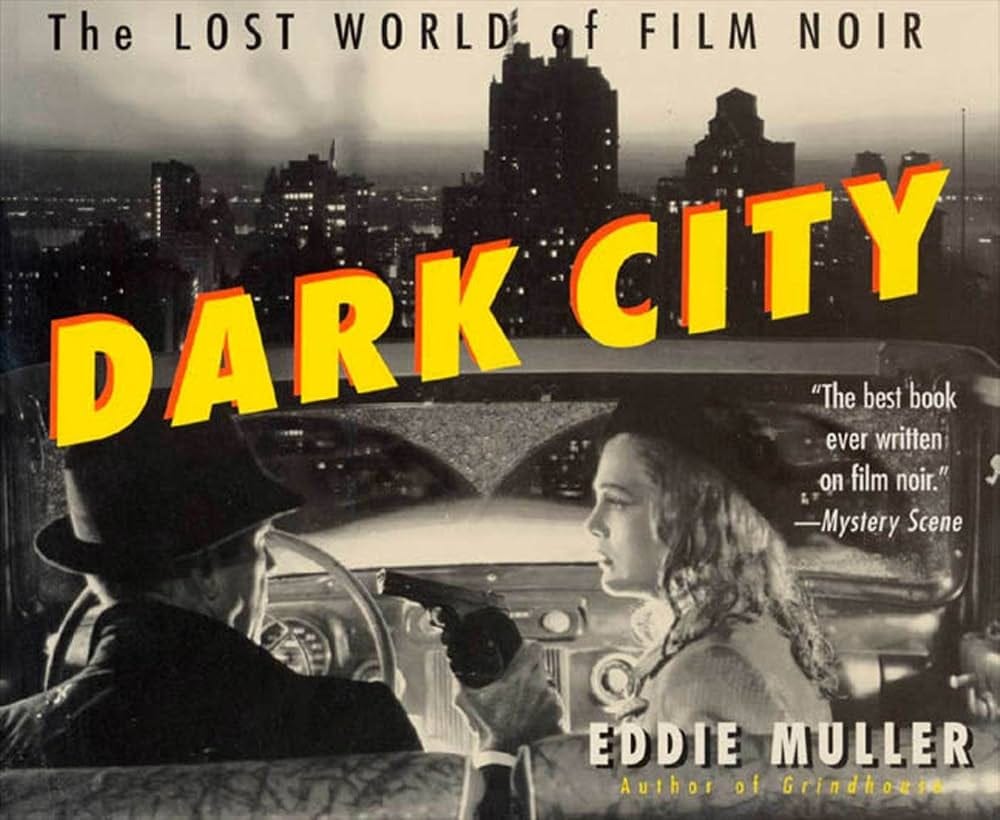
Dark City by Eddie Muller is the best single book on noir. I met Eddie in Davenport Iowa 25 years ago before I became an author and write "noir" detective style books myself. I bought a couple of his books that he signed. Now he is a living legend on "Noir."
Another great article Steve!