

MAKE MINE MANCINI
Jazzing up a TV show launched a career.

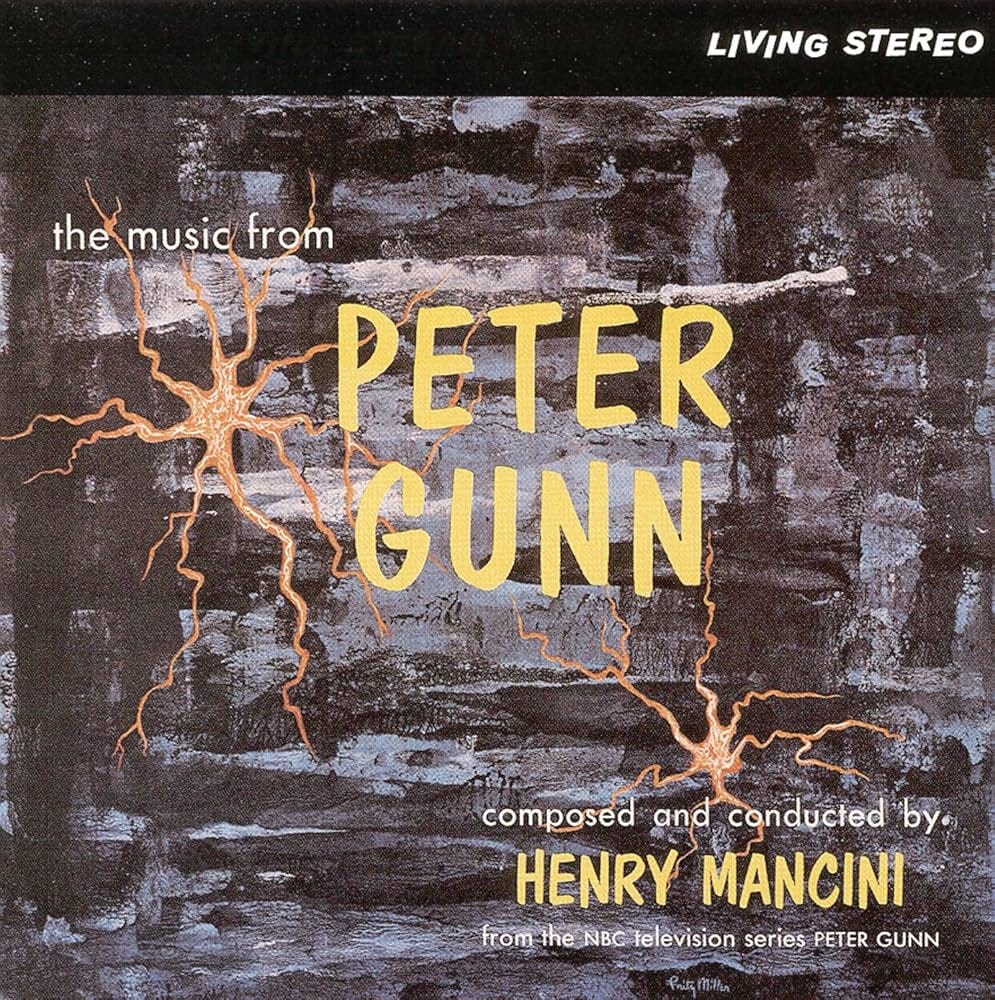
In his book, Henry Mancini…Reinventing Film Music, John Caps explains that Mancini had come to a crossroads in his career in 1958 after Universal Studios closed their music department where the young composer was employed.
“Mancini had been making $350 a week…now he was making nothing. Mancini was out of a job. Ginny (his wife) was still working as a freelance studio singer around Hollywood but the pay, if generous, was not continuous. Meanwhile, at home were six-year-old twins and an eight-year-old son,” stated Caps.
Now comes the Hollywood touch. “Although he was no longer a staff composer at Universal, he still retained his studio pass, with which he could enter the movie lot, use the cafeteria, mingle informally with producers, and on one important occasion, visit the studio barber shop,” Caps wrote.
It was there at the barber chair that he ran into producer Blake Edwards who had just gotten the go-ahead to launch a new TV series for NBC in the fall. The show was Peter Gunn, not a western that Mancini initially thought from the title, but a private-eye show.
This was about a modern private eye who frequented a nightclub called Mother’s where West Coast jazz was the order of the day.
Mancini had his own ideas for the show. He’d already used jazz for his work on the score of Touch of Evil, the Orson Welles movie now considered a film-noir masterpiece. Of course, that’s not how Universal looked at the Welles film at the time, noted Caps: “Now a half millions dollars in debt, (Universal) had been hoping for a tight, hot salable thriller film from Welles, not this unclassifiable character study with its seedy amoral universe, dark look, and cast of crazies.”
But using jazz-pop in Peter Gunn proved to be a touch of genius for Mancini, who not only developed perhaps the most celebrated TV theme of all time but provided each episode of Peter Gunn with its own jazzy score.
The Peter Gunn theme was not only a hit for Mancini but for Ray Anthony, Duane Eddy (who made the charts with his version in 1960 and again in 1987 with the Art of Noise), and Deodato in the 1970s. Second Hand Songs, a website that tracks songs on the market, lists over 200 versions of the song that have been recorded to date.
Edwards stated that Mancini’s scores were responsible for at least 50 percent of the show’s success. The TV show stuck around for three seasons and 114 episodes but the Peter Gunn album (with other great cuts like “Dreamsville,” “Sorta Blue,” and “Fallout”) did even better. The number one album in the country for 10 weeks in 1959, it was the first TV soundtrack album to top the charts.
Mancini recalled what a difference the success of Peter Gunn made. “He later wrote about the period of unemployment between the demise of the Universal music department and the start of Peter Gunn,” wrote Caps.
“Even once the new show started, he was struggling to make ends meet,” Caps stated. “(Mancini) well remembered having only five dollars in the family bank account on the very day his first royalty check for the Peter Gunn album arrived in the mail. He drove over to where Ginny was doing her charity work and showed her the check—for $32,000 (that represents buying power of $350,000 in 2026).”
Things were looking up. Half the Peter Gunn fan mail was reportedly for Mancini. CBS offered Edwards a contract to do a show—as long as Mancini was part of the package.
Mancini scored again with that second show, Mr. Lucky, which gave the composer the opportunity to integrate more Latin themes into the soundtrack. The Mr. Lucky soundtrack album was another another hit record, going to number-two on the charts and picking up more Grammy Award nominations that Peter Gunn received. While the TV show only lasted a year, the Mr. Lucky theme went on to become one of the most-played songs on middle-of-the-road radio stations across the country for the next five decades.
As we know now, there was no turning back for Mancini who, after his initial TV success, went on to craft tunes like “Moon River,” “Pink Panther,” “Charade,” and “Baby Elephant Walk,” to name just a few.
Another Great Read, sir!
I've been listening to Art of Noise for the past week. Found this gem on YouTube. Cheers!
https://www.youtube.com/watch?v=o-PiWgXbOp4&list=RDo-PiWgXbOp4&start_radio=1