

MORE ON CORN
The farm press doesn't have a monopoly on discussions involving U.S. agricultural policy.

“If you eat, you’re involved with agriculture.” That’s the line used by Orion Samuelson, the longtime ag reporter at WGN radio in Chicago, who died recently at the age of 91.
The Big O was telling us city folks who can’t tell a cover crop from a cover-up that we need to pay attention to what’s happening on the farm.
Here in central Illinois, we know that farmers are facing higher costs and more uncertainty than ever.
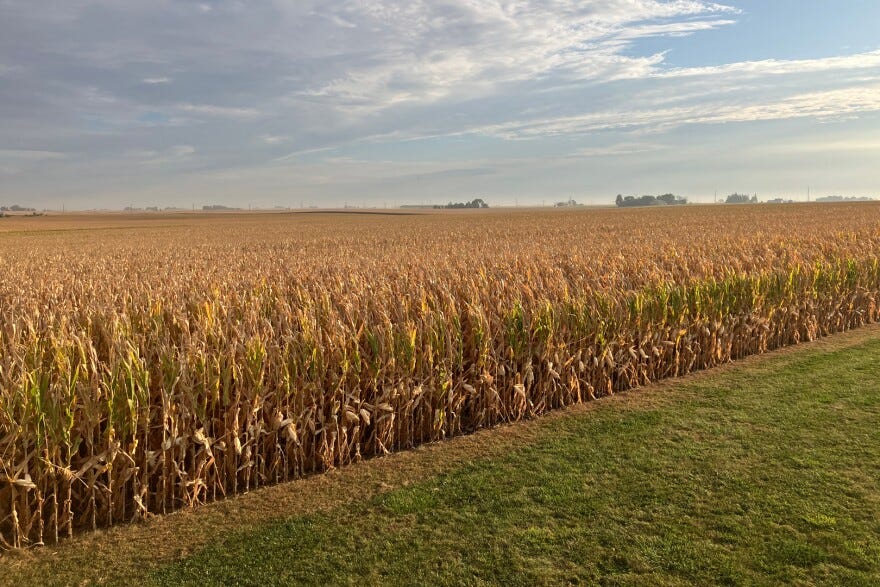
The two big crops—corn and soybeans—each come with their own set of problems. For corn, the industrial variety that goes mostly toward ethanol and animal feed, farmers tend to rely heavily on nitrogen fertilizer.
Fertilizer costs, which were high already, shot up thanks to the war in Iran.
The best source of nitrogen is natural gas. That makes the Persian Gulf the nitrogen fertilizer hub of the world. Upset the supply chain there, and farmers looking to load up fields before planting face trouble.
Farmers can turn to soybeans that require less in the way of fertilizer but face a less-than-rosy export market. Tariff issues and expanded production from South American countries have complicated things. China, the nation’s biggest trade partner, is still buying but not as much.
The farm economy is hurting right now. Low crop prices make it difficult for farmers to pay back loans to cover production costs. Farm bankruptcies are on the rise.
On top of that, farmland costs remain high, so it’s hard for new farmers with new ideas to enter the field. I say new ideas because it may be time to rethink the reliance on corn and beans.
If this sounds like heresy in the Corn Belt, consider other costs the farm press chooses to ignore—namely, the health of our soil and water in this country, as well as the health of the farmers and the communities they serve.
Bill Knight’s recent story in this April’s edition of the Community Word raised the connection between pesticide use and cancer rates. Using USDA and National Cancer Institute statistics, pesticide use on Tri-County (Peoria, Tazewell, and Woodford Counties) farms is eight times more than the national average, while cancer rates are 10 times higher, Knight wrote.
Other corn-producing regions have seen a correlation between what’s washing out of farm fields and winding up in humans. Nitrates and phosphates in drinking water have been implicated in Iowa’s rising cancer rates.
There are also warnings about the nation’s soil health. “Some 92 million acres of land seeded to corn each year in the United States lose an average of 5-8 tons of topsoil per acre annually,” noted Kurt Lawton in a 2017 article for Farm Progress.
So who’s to help the farmer? One of the problems is that the current support system (including the government) favors chemical farming. But let’s be fair. It’s not just farmers looking for a chemical fix. Take a look at how much Round Up is on sale at your local hardware store.
Organic farming, while growing steadily nationally, is still sometimes projected as a fringe group by the industrial-farm complex that dominates American agriculture.
But there are encouraging signs out there. The Jan. 29, 2025, story in Organic and Non-GMO Report by Keith Schneider suggests that people searching for ways to check the impact of industrialized American agriculture make a visit to Clear Creek Acres in northern Iowa.
“With just shy of 800 residents, West Bend, Iowa is barely a blip on a prairie landscape, but it has become home base for an uncommonly large expanse of organically grown crops—operations that have found success in challenging the popular convention that pesticides and other agricultural chemicals are needed to feed the world,” noted Schneider.
“Towering grain bins are surrounded by close to 50,000 acres of corn, soybeans, oats, and other crops grown without the use of synthetic chemicals. Farmers fertilize the land with chicken litter and hog manure and weed much of the land by hand, or with non-chemical tools, such as new laser weeders,” he added.
You can find other stories like that so I hope it doesn’t sound like we’re piling on when it comes to encouraging U.S. farmers to break their chemical dependency. Just recall Samuelson’s statement. We’re concerned. After all, we’re all involved.