

NANCY DREW
B movie from 1939 tops my list of comfort films.

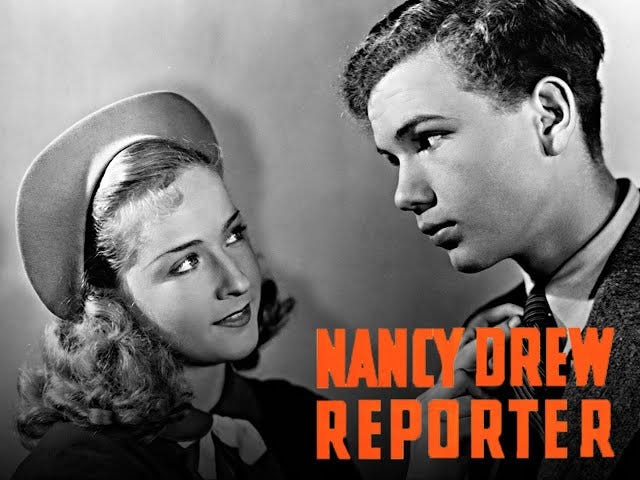
In this, an entertainment era of near-infinite availability, where it’s become so easy to select our own amusements., everyone has their own parcel of “comfort cinema.”
These are movies you’re willing to watch repeatedly, where you know the plot, characters, and even the dialogue cold. But you don’t mind. In fact, the familiarity is part of the charm.
My list is probably what you’re expect from a film-noir fiend: Casablanca, Fifth Element, Kiss Kiss Bang Bang, Invasion of the Body Snatchers, DOA, King Kong, and a couple of World War II works from Hitchcock, Foreign Assignment, and Saboteur. I have to include North by Northwest, too.
But sitting atop this list is a 1939 B movie, Nancy Drew Reporter. That movie speaks to me. Not just because of the newspaper setting, but the film’s innocence is captivating.
Bonita Granville played a feisty Nancy in four films made in 1938-1939 with Frankie Thomas (pictured with Bonita above) as Ted, the boyfriend who’s manipulated but doesn’t mind, and John Litel as Carson Drew, well-known lawyer about town and Nancy’s single-parent Dad.
In Reporter, Nancy is the put-out student who wants to make an impression on the city editor with a story defending a woman accused of murder. That city editor, by the way, is played by Thomas Jackson.
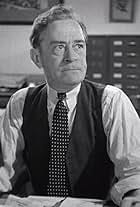
A little on him: Jackson’s 67-year career spanned eight decades. He started as a 12-year-old on Broadway. He went on to appear in over a dozen plays on Broadway, produced two others, and acted in over 130 films and television shows.
I didn’t know this when I first watched the film, but it might explain why Jackson is so convincing as the old-school newspaper guy just trying to do his job (with little time for shepherding a bunch of school kids around the newsroom).
I’ve enjoyed subsequent Nancy Drew portrayals, particularly the effort from Emma Roberts, who was just 15 when she made the movie in 2007. It’s the kind of role that you can adapt to the times. But it’s Bonita in good old black-and-white that I always come back to.
But then it’s not surprising that the film has an impact. After all, it was made in 1939, a year like no other for movies. Some of the shows produced that year include Gone with the Wind, The Wizard of Oz, Stagecoach, Goodbye, Mr. Chips, and Mr. Smith Goes to Washington. I’ll still take Nancy.