


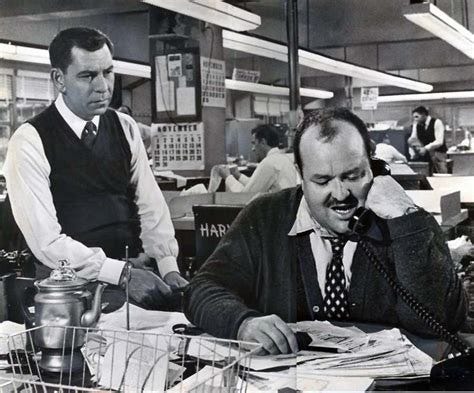
The movie carries the title -30-. One Night in the Newsroom would have been better, but that’s beside the point now. Made in 1959 by Jack Webb in his post-Dragnet phase (he picked the show up again for a three-year run in 1967—this time in color), the movie takes place in a Los Angeles newspaper office.
The real star of the show is William Conrad, above, who’s on the phone as Webb looks on. Conrad plays the boisterous city editor who delivers a rundown on the press that must have been an eye-roller when the film was released some 75 years ago.
At one point in the film, Conrad goes off on a copyboy at the paper who shows a lack of respect for the whole journalism thing. “You know what people use these for? They roll them up and swat their puppies for wetting on the rug. They spread them on the floor when they’re painting the walls; they wrap fish in them; shred them up and pack their two-bit china in them when they move –or else they pile up in the garage until an inspector declares them a fire hazard!” shrieks Conrad.
“But this also happens to be a couple of more things! It’s got print on it that tells stories that hundreds of good men all over the world have broken their backs to get. It gives a lot of information to a lot of people who wouldn’t have known about it if we hadn’t taken the trouble to tell them. It’s the sum total of the work of a lot of guys who don’t quit. It’s a newspaper, that’s all. Well, you’re right for once, stupid. And it only costs 10 cents, that’s all. But if you only read the comic section or the want ads–it’s still the best buy for your money in the world.”
If that doesn’t buckle your britches after seeing what’s happened to the newspaper industry in the 21st century, I don’t know what will.
Now let’s talk about the man who delivered that speech and went on to become Cannon, the middle-aged, overweight detective who stomped about the TV scene in the 1970s.
The guy had a voice, and he could act—on the radio, on TV, and in the movies. I’m given to lists, and I’ll be the first to admit this is a contrived one, but Conrad deserves to be recognized for all that he did--and he did a lot.
“In -30-, Conrad gives his greatest screen performance as a bullying, sarcastic night city editor named Jim Bathgate — jeez, I actually worked with more than one guy like this back in the ’60s and early ’70s,” noted film critic (now retired) Lou Lumenick in a column he wrote for the New York Post in 2010 (when -30- was released on DVD).
The movie role that captivates me even more than -30- is his appearance as a hired gun (along with Charles McGraw) in The Killers (1946). Starting with the opening credits and the first 10 minutes, we follow the bad guys into town who are looking for Swede. It’s riveting and it’s classic Conrad. If you heard this guy on the radio, you knew he could throw his weight around (let’s just call him burly).
I’ll leave it to the amazing Elizabeth McLeod to provide a little background. Here’s her opening paragraph for a piece she did for Radio Classics under the headline, “William Conrad: the Voice of Postwar Radio.”
“Authoritative, resonant, and powerful. Sensitive, thoughtful and compassionate,” noted McLeod. “Few actors of the radio era combined all these qualities so thoroughly as the man who, in many ways, encapsulates all that was most creative and most memorable about postwar radio drama.”
“William Conrad seemed to be everywhere on the air in the 15 years following the end of the Second World War. Even later, when radio was reduced to a shadow of its former self, William Conrad remained a booming voice in commercials and special features right up until the end of his own life. Even the most casual of ‘old time radio’ enthusiasts know his most famous role, the definitive western hero Matt Dillon. But William Conrad had a career far more varied, far more interesting, and far longer-lived than even that legendary portrayal,” McLeod stated.
William Conrad Top 10:
1. The Killers. There’s real fear in that diner, and Conrad’s responsible.
2. Gunsmoke. The radio version ran from 1952 to 1961. Conrad played Matt Dillon in a way that, as you listen to the program (and you can hear the show over the internet), you’re right there in Dodge City on the lookout for “the killers and the spoilers” (part of the show’s regular introduction that’s delivered by Conrad). Trivia note: Howard McNear (Floyd the barber from Andy Griffith), who has a small part in -30-, played Doc on the radio version of Gunsmoke.
3. -30-. Anyone who’s worked in a newsroom of any kind or size knows Jim Bathgate.
4. Escape. It was the radio program that didn’t get any respect. The kid sister of the CBS stalwart Suspense, Conrad’s fingers (and vocal chords) were all over this show. “Leiningen Versus the Ants” is a noteworthy episode where Conrad plays the headstrong owner of a plantation in Brazil facing an army of ants.
5. Dial 1119. Conrad plays Chuckles, the bartender, in a bar with a big-screen TV back in 1950, a film noir that heralded the arrival (and intrusion) of television.
6. Rocky & Bullwinkle. Narrator duties. What voices abounded on this show!
7. Fugitive. More narration. Conrad’s voice at the show’s opening and end set the tone for the anguish and despair that faced Richard Kimble, the man on the run looking for the one-armed man who killed his wife.
8. Cannon. You didn’t have to be a pretty boy to catch the crooks on TV.
9. Jake and the Fatman. Another TV show and his last role.
10. Conrad directed three films all released in 1965: Two on a Guillotine, My Blood Runs Cold, and Brainstorm. “It’s possible there’s never been as offbeat a big-screen trifecta directed by one director in a single year,” noted writer Keith Roysdon in CrimeReads.
The Community Word newspaper, published in Peoria, must be commended for continuing the tradition of print journalism and for offering DVD copies of -30- (while supplies last) to new subscribers. Check out their website at thecommunityword.com.
Bill Conrad had one of the most distinctive voices ever. No wonder he was first-call for so many productions both as an in-person and voice actor. He had no affectation either; he didn't have to go deadpan or exaggerate in the Rocky & Bullwinkle narrations - he could just be himself, sounding exactly as he did elsewhere, and it would be as hilarious as he was serious, sounding the same, in those other contexts. But I didn't know he was also a director. Did he ever do anything other than those three films from 1965?