


In the word-association game, if I say “prehistoric creatures,” you say “dinosaurs.” Understandable. After all, dinosaurs surround us today: on film, across the toy aisle, and adorning children’s clothing (holding their own against unicorns and mermaids).
Dinosaurs represent a wildly varied group of animals—from sly little egg-snatchers to lumbering behemoths. They’re blissfully docile or frighteningly ferocious. On land or sea, they serve as real-life models for the dragons and sea serpents that populate our storybooks.
Yet the meteor strike that brought an end to the reign of the dinosaurs didn’t bring an end to strange creatures roaming the Earth.
The amazing thing—to me, anyway—is how long many of the creatures in the post-dinosaur period took up residence on this planet.
The ubiquitous T.rex had a good run, according to researchers, stomping about for a stretch estimated to have lasted between 1 and 3 million years before the lights went out.
Compare that to two of my favorites from the Cenozoic Era: the terror birds and Hell pigs, which were apex predators for about 20 million years. As Riley Black of Smithsonian Magazine noted, “Life didn’t shrink after the end of the Cretaceous.”
You probably know about mammoths and mastodons, giant elephants that snorted about these parts. But did you know that scientists think they did that snorting for 6 million years?
But the mighty pachyderms were veritable short-timers compared to the ground sloths that are believed to have existed for 35 million years.
The ground sloth category is interesting. They carry names like Mylodon (Charles Darwin found one) and Megatherium, and weighed several tons, eating only vegetation, apparently a lot of it.
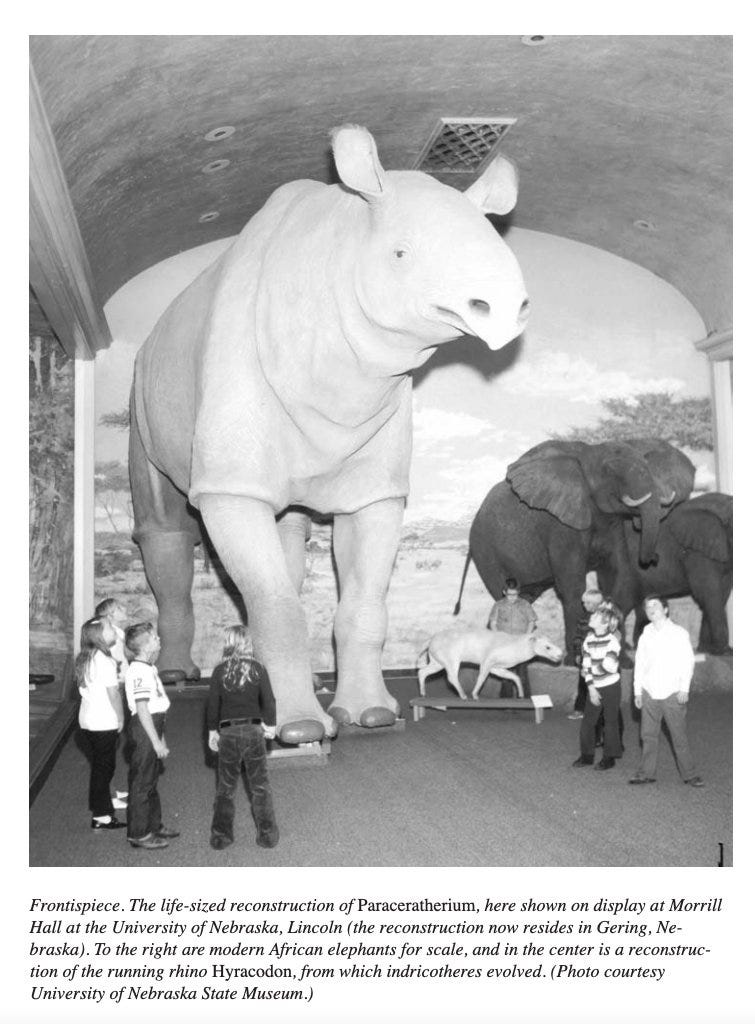
When it comes to size, however, the champion is the Paraceratherium, an ancient relative to the rhino family. This guy was huge.
I ran into a life-size model at the University of Nebraska in the 1980s (sadly, it’s not there anymore). This thing floored me when I walked into the museum on the university grounds. How could this giant, weighing 20 tons—as much as five elephants—escape scrutiny?
(The photograph above is from museum literature of the day before the reconstruction was removed because it contained asbestos.)
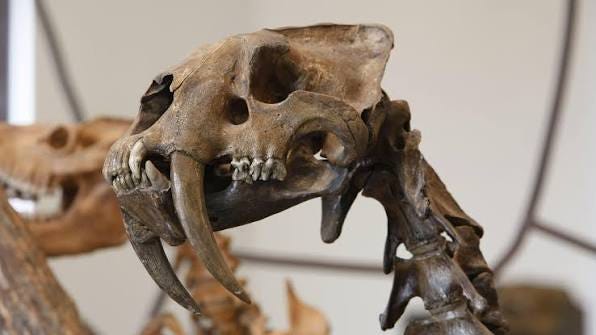
Not escaping scrutiny was a creature I remember being called a saber-toothed tiger when I was a kid. The formal name is Smilodon.
A recent article by Margherita Bassi in Smithsonian Magazine revealed that the famed La Brea Tar Pits in Los Angeles contain the remains of 4,000 Dire Wolves and 2,000 saber-toothed cats.
The Dire Wolf was a carnivorous canine weighing about 150 pounds that hunted (usually in packs) bison, horses, and ground sloths. The Dire Wolves and saber-toothed cats only went extinct about 10,000 years ago.
Scientists speculate that one of the reasons for their extinction was the arrival of a new adversary: human beings. Today, 20 species of wild cats are classified as endangered. The reason? The same problem that Smilodon faced: man.